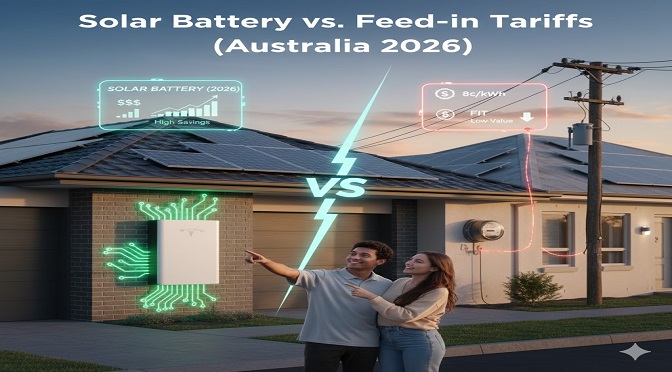
For years, Australian homeowners with solar panels enjoyed generous Feed-in Tariffs (FiTs), essentially getting paid a decent rate for exporting their excess solar power back to the grid. In 2026, the landscape has fundamentally shifted. The question is no longer “should I get a battery or just export?” but rather, “how quickly can a battery recoup the savings I’m losing on declining FiTs?”
This blog will dissect the current state of FiTs, the rising dominance of solar batteries, and help you understand which strategy offers the best financial return for your home in 2026.
The Declining Reign of Feed-in Tariffs in 2026
The days of 20-30c/kWh FiTs are, for the most part, a distant memory. In 2026, the average residential FiT across Australia hovers dramatically lower:
- NSW: 5-8c/kWh
- Victoria: 3-6c/kWh (minimums deregulated further in 2025/2026, leading to lower offers)
- Queensland: 5-9c/kWh
- South Australia: 6-10c/kWh
- Western Australia: 2.5-7c/kWh (Synergy/Horizon often offer slightly better, but still low)
Why the Decline? The primary reason is the sheer volume of solar on the grid. As more homes generate power, the supply increases, driving down the value of exported electricity. Grid stability concerns and changes in wholesale market dynamics also play a role.
The Rise of the Battery: A New Economic Reality
With low FiTs, every unit of solar power you consume yourself is far more valuable than every unit you export. This is where the solar battery becomes indispensable.
The “Value Gap” in 2026: Consider this:
- Cost to buy from grid (peak): 35-50c/kWh
- Value of exporting to grid (FiT): 3-10c/kWh
- Value of self-consuming (battery): You save the 35-50c/kWh you would have paid!
This “value gap” of ~30-45c/kWh is the battery’s strongest selling point. A battery allows you to store your cheap daytime solar and use it during expensive evening peak hours, directly offsetting the highest-cost electricity you would otherwise buy.
The 2026 Showdown: Battery vs. Export
Let’s break down the financial implications.
Scenario A: Exporting Excess Solar
- Pros: Zero upfront cost for the “storage” (you’re using the grid as your battery). Simple.
- Cons: Very low financial return. You’re effectively giving away cheap power and buying expensive power. High electricity bills due to peak usage.
Scenario B: Adding a Solar Battery
- Pros:
- Maximised Self-Consumption: Drastically reduces electricity purchased from the grid, especially during peak times.
- Blackout Protection: Provides backup power during outages.
- Virtual Power Plant (VPP) Income: Many retailers offer payments (e.g., $100-$250/year) for allowing them to occasionally draw from your battery during grid stress.
- Reduced Carbon Footprint: Increased reliance on your own renewable energy.
- Cons: Upfront cost (though federal and some state rebates significantly reduce this). Payback period typically 5-10 years.
When Does a Battery Make Financial Sense in 2026?
A solar battery is an excellent investment if:
- Your current FiT is below 10-12c/kWh. (This is most of Australia in 2026).
- You have significant evening/night-time electricity consumption. (e.g., air conditioning, electric vehicle charging, large families).
- You want blackout protection.
- You qualify for federal (STC) or state battery rebates.
Case Study (Typical Home, NSW):
- Average daily consumption: 20 kWh
- Daytime solar generation: 25 kWh
- FiT: 7c/kWh
- Peak grid price: 40c/kWh
- Battery Cost (after rebates): ~$10,000 (13.5kWh usable)
Without a battery, you might export 10 kWh daily for 70c and buy 10 kWh daily for $4.00. With a battery, you store that 10 kWh and use it, saving $4.00. This $3.30 daily saving (plus any VPP income) leads to a payback of ~7-8 years.
FAQ’s
Highly unlikely in the near future. The trend is firmly downwards due to grid saturation and market dynamics.
It can drastically reduce it, often to just the daily supply charge. Complete elimination depends on your usage patterns, solar size, and battery capacity.
Most homes find 10kWh to 14kWh sufficient to cover evening peak demand. It's best to size it based on your actual consumption profile.
Yes, if your battery is full and your panels are still generating excess, that power will be exported to the grid, earning the prevailing FiT.
- By: web admin
- Tags: #2026Solar, #ElectricityBillsAU, #EnergyStorageAU, #FeedInTariffAustralia, #HomeBattery, #RenewableEnergy, #SolarBatteryAustralia, #SolarSavings, #SolarVsBattery
- 0 comment