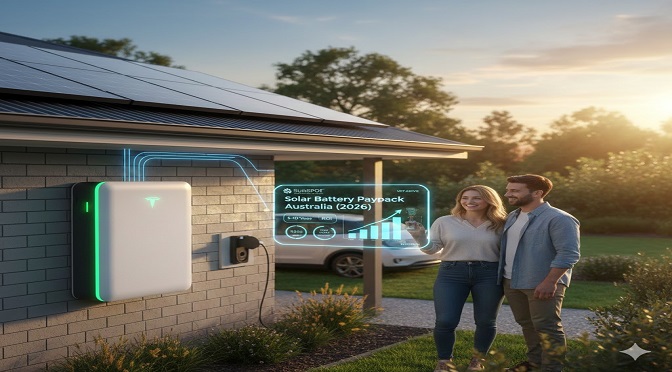
If you are looking at your electricity bill in 2026, you’ve likely noticed a widening gap between what you pay for power and what you get for “selling” it back to the grid. This gap is exactly why home batteries have moved from a “luxury tech” item to a mainstream financial strategy for Australian households.
The Short Answer: What is the Payback Period in 2026?
For most Australian homes, the payback period for a solar battery now ranges between 5 and 10 years.
However, high-consumption households (especially those with EVs) or those in states with aggressive incentives can see “break-even” points as low as 3 to 4 years.
Key Drivers of Battery ROI in 2026
The “Death” of the High Feed-in Tariff
In 2026, Feed-in Tariffs (FiTs) across states like Victoria and NSW have dropped significantly, often hovering between 3¢ and 8¢ per kWh. Meanwhile, peak evening grid prices can exceed 35¢–45¢ per kWh.
The Logic: Every kWh you store and use at night saves you ~30¢, whereas selling it only earns you ~5¢. This 6x value difference is the primary engine of your battery’s payback.
2026 Rebate Changes (The “May 1st” Rule)
The federal Cheaper Home Batteries Program underwent a major shift on May 1, 2026.
- The Incentive: You can still receive roughly $3,000 to $4,500 off a standard 13.5kWh battery via Small-scale Technology Certificates (STCs).
- The Tapering: From May 2026, rebates are now tiered. Systems under 14kWh receive the full subsidy, while larger systems see a reduced rate for the extra capacity. This makes “right-sizing” your battery more profitable than over-sizing.
Average Payback by State (2026 Estimates)
Based on 2026 electricity prices and available state-specific “Virtual Power Plant” (VPP) incentives:
| State | Est. Payback (Years) | Key Factor |
| South Australia | 4.5 – 6.0 | Highest grid prices + strong VPP participation. |
| NSW / QLD | 6.5 – 8.5 | Falling FiTs make self-consumption highly profitable. |
| Victoria | 7.0 – 9.0 | Impacted by 2026 deregulation of FiT minimums. |
| Western Australia | 6.0 – 7.5 | High sunlight hours and Synergy/Horizon incentives. |
How to Calculate Your Potential Payback
To get a realistic number, use this simple formula or an online calculator like SunSPOT:
Payback Period (Years) = Net System Cost (After Rebates)\{Annual Bill Savings} +VPP Income
- VPP Income: Many retailers now pay you $100–$250/year to occasionally “borrow” your battery during grid emergencies. This can shave 12–18 months off your payback period.
Why 2026 is the “Smart” Year to Buy
- Warranty Alignment: Most premium batteries (Tesla, BYD, Sungrow) now carry 10 to 15-year warranties. With a 7-year payback, you enjoy 3 to 8 years of “pure profit” electricity.
- EV Integration: If you charge an Electric Vehicle at night, a battery is almost essential to avoid massive “peak-time” charging costs.
- Blackout Protection: With increased grid volatility, the “insurance” value of backup power is a non-financial bonus many Australians now prioritize.
FAQ’s
Not necessarily. In 2026, the "sweet spot" is a battery that covers your evening usage (usually 10kWh–14kWh). Going larger increases upfront costs faster than it increases savings, potentially lengthening your payback.
Not always, but most 2026 batteries work best with at least 6.6kW of solar. If your system is older than 8 years, a full "Solar + Battery" package often has a better combined ROI.
After federal rebates, a standard 10kWh–13kWh battery typically costs between $8,500 and $12,000 fully installed.
- By: web admin
- Tags: #CheaperHomeBatteries, #ElectricityPricesAustralia, #EnergySavings2026, #RenewableEnergyAU, #SolarBatteryAustralia., #SolarROI, #TeslaPowerwallPayback, #VPP
- 0 comment