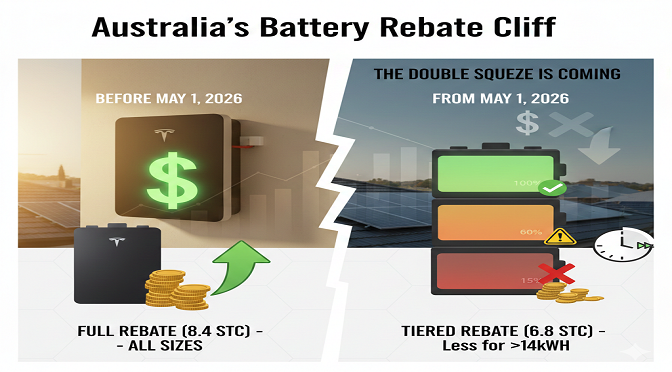
The Australian federal government’s Cheaper Home Batteries Program is entering a transformative phase. While the program’s budget has been expanded to $7.2 billion to ensure viability through 2030, the “golden era” of flat-rate subsidies is ending.
From May 1, 2026, a new tiered system and accelerated rebate drops will fundamentally change the math for home energy storage. If you are considering a battery larger than 14kWh, waiting could cost you thousands.
The May 2026 Shift: What is Changing?
For the first time, the federal government is moving away from a “one-size-fits-all” rebate. The goal is to encourage right-sized batteries—systems that match a home’s daily usage rather than just maximizing capacity for the sake of the subsidy.
The New Tiered Rebate Structure
Starting May 1, 2026, the rebate will be applied in three distinct bands based on usable capacity:
| Battery Capacity Band | Rebate Support Level |
| 0 – 14 kWh | 100% (Full support for typical homes) |
| 14 – 28 kWh | 60% (Reduced support for medium systems) |
| 28 – 50 kWh | 15% (Minimal support for large systems) |
The “Double Squeeze”: Faster STC Reductions
The Small-scale Technology Certificate (STC) factor—the multiplier that determines your total discount—is also changing. Instead of annual drops, the STC factor will now decrease every six months (January and July).
- Before May 1, 2026: STC Factor is 8.4.
- May – Dec 2026: STC Factor drops to 6.8.
- Ongoing: It will continue to decline until the program ends in 2030.
Real-World Impact: The Cost of Waiting
Timing your installation is now a financial priority. Because the rebate is locked in at the date of installation (not the date of purchase), homeowners must act early to secure 2025/early 2026 rates.
Example: The 13.5kWh vs. 28kWh Comparison
- Standard 13.5kWh Battery (e.g., Tesla Powerwall 3): Under the new rules, this remains well-supported. However, the drop in the STC factor from 8.4 to 6.8 means even these systems will see a discount reduction of roughly $800–$1,000 if installed after May 1.
- Large 28kWh System: This is where the impact is massive. By waiting until after May 2026, a homeowner faces both the lower STC factor and the 60% tapering on the second half of their battery. This can result in a loss of over $3,500 in total rebate value.
Why the Government is Reframing the Program
The Australian Government’s decision to “slow down” the subsidy for large systems stems from two main drivers:
- Sustainability: High uptake nearly exhausted initial funds. The tiered system ensures the program stays open for more Australians until 2030.
- Grid Resilience: Experts want to discourage “oversizing.” A 10–14kWh battery is the “sweet spot” for most Australian households to achieve 90% energy independence without putting undue stress on the local grid.
FAQ’S
Key Takeaways for Homeowners
- Large Systems (>14kWh): Install before May 1, 2026, to avoid the tiered reduction.
- Small Systems (<14kWh): You are safer, but still face a ~20% rebate drop on May 1 due to the STC factor change.
- Lock it in: Ensure your installer can guarantee an installation date before the deadline to secure the higher rate.
- By: web admin
- Tags: AustraliaBatteryRebate, CheaperHomeBatteries, EnergyIndependence, HomeBatterySavings, RenewableEnergyAU, SolarStorage2026, STCFactor, TeslaPowerwall
- 0 comment